(1).jpg)
THE WORLD’S OLDEST CHILDREN’S FESTIVAL
On the night when the prophet Isa (Jesus) was born, a great star appeared in the sky. “It is a sign that a great birth has taken place on earth,” they said. This event marks the beginning of the sorrowful story of the world’s oldest children’s festival.
Children love festivals the most. For they are not only days of joy, but also days of entertainment, dressing well, and eating good food… There are also festivals specifically for children, and the oldest of them is two thousand years old. Although April 23 in Türkiye is described as “the first and only children’s festival,” this children’s festival called Childermass has been celebrated in the Christian world for centuries.
What He Feared Came to Pass
The history of Childermass goes back to the time of the prophet Isa (peace be upon him). The reason for the festival is based on an unpleasant event such as the brutal massacre of thousands of children in Palestine. The prophet Isa was born in the town of Bethlehem in Palestine. When Maryam (Virgin Mary), the daughter of Imran, one of the leading members of the Jewish community, gave birth to a fatherless child through the insemination (talqih) of Ruh al-Quds, she became very afraid. Ruh al-Quds is the archangel Jibril (Gabriel). Allah does not breathe a soul into human beings. When Allah wills to create a person, a command is given in the realm of souls to that person’s soul; it goes and enters the created body. Only by the command of Allah was a soul breathed into Maryam, and thus the Prophet Isa was born.
Fearing that the Jews would accuse her of unchastity and harm the child, she came to Bet-Maqdis (Jerusalem). When the child was one week old, he was circumcised according to the sharia of the Prophet Musa (Moses), and upon the indication of Jibril, he was given the name Isa. Isa (Hebrew Yeshua, Latin Iesus) means the help (hoshea) of Allah (Jehovah).
What Maryam feared came to pass. Her brother-in-law and protector, the Prophet Zakariya (Zechariah), was accused and killed. Maryam fled with her son toward Damascus. She lived for a while in the town of Malula, where she sought refuge. The mountain which is said to have split in two and given them passage upon the arrival of Maryam and her son is still visited today.
At that time, Palestine was ruled in the name of Rome by a cruel king named Herod the Great, who was not of Jewish origin and had adopted Greek culture. He adorned his palace with statues, but since Jewish sharia prohibited images and statues, he had coins minted without even pictures so as not to incur the hatred of the people.
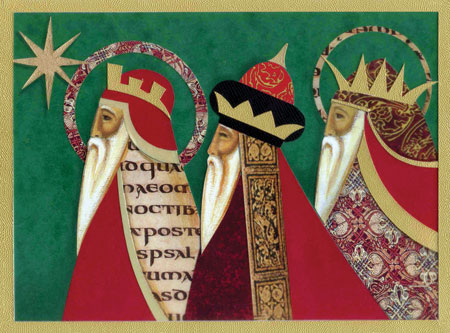
On the night when Isa was born, a great star had appeared in the sky. The soothsayers said, “This is a sign that a great birth has taken place on earth.” The Shah of Iran also sent envoys with gifts in all directions. The astrologers determined that the place where the star had appeared was Bethlehem and informed Herod in Jerusalem. Remembering the words of the Prophet Micah, “The leader who will shepherd my people Israel shall come forth from Bethlehem,” Herod was greatly afraid. With feigned joy, he said, “Find that child so that I too may believe.”
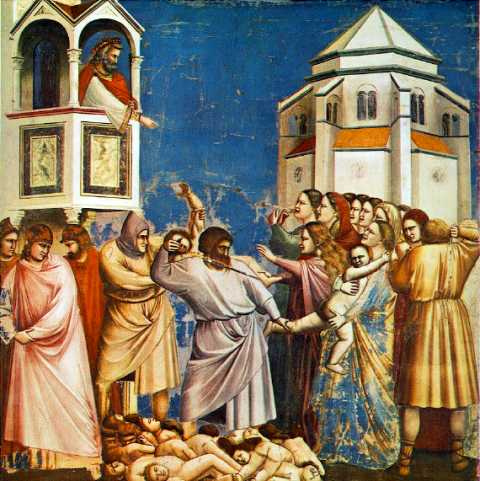
The astrologers found Isa and believed in him. They presented their gifts. However, angels came and warned them not to return to Herod. So they returned to their own country. Alarmed, Herod ordered that all male children born within two years in Bethlehem be killed. This story is narrated in the Gospels of Matthew and Barnabas.
The Lament of Rachel
Upon the dreadful command, thousands of children were taken from their mothers’ arms or from their cradles and slaughtered. Even Herod’s own son was among them. Indeed, upon hearing of the event, the Roman Emperor could not refrain from saying, “It is better to be Herod’s pig than his son.” The pig is an animal whose flesh is not eaten in Jewish sharia and therefore is not killed. Thus the words of the Prophet Jeremiah were fulfilled: “A voice is heard in Ramah. Rachel weeping for her children.” Rachel was the wife of the Prophet Yaqub (Jacob) and the grandmother of the Israelites. Her grave is in Ramah.
The number of the slain children is given as 14,000 in Greek sources, 64,000 in Syrian sources, and 144,000 in some medieval sources. Modern writers consider these numbers exaggerated. Indeed, Bethlehem was a small town at that time. An interesting aspect of the event is that a similar one occurred during the time of the Prophet Musa. Because of this similarity, some modern writers claim that Herod’s massacre may have been fabricated.
Meanwhile, Yusuf (Joseph), the betrothed of Maryam, was commanded in a dream to take the newborn child and his mother to Egypt in order to protect them from the evil of this tyrant king. When he awoke, he immediately took the child and his mother and brought them to Egypt. The Quran states in meaning regarding this matter: “And We made the son of Mary and his mother a sign, and gave them refuge on high ground—a suitable place for rest with flowing water” (Muminun: 50). In most tafsir (Quranic exegesis) works, it is reported that this place was Egypt. They remained there for twelve years. When Herod died, Yusuf was again told in a dream to take the child and his mother and return. They first came to Galilee, then to Nazareth. Since Isa grew up there, he would later be known as Jesus of Nazareth.
The Holy Innocents
In 485, it was accepted that these children were the first martyrs on the path of the Messiah. In the early times, their commemoration was held together with the Feast of Epiphany (January 6), which is one of the oldest and most important feasts of Christianity alongside Easter and Christmas, during which the visit of the astrologers was remembered. Later, December 28, the day on which the massacre is supposed to have occurred, was declared the Feast of the Holy Innocents.
This festival, called Childermass in England, is celebrated by the Greeks on December 29, and by the Syriacs and Nestorians on December 27. In those days, in Ancient Rome, there was the festival of Saturnalia. During those days, people did not work; children and slaves behaved as they pleased and said whatever they wished; certain rules of propriety were overlooked, and gifts were given.
In the Middle Ages, these festivities were banned on the grounds that they belittled religion. In fact, in England, in order to show that this feast was a day of mourning, children were lightly whipped in their beds in the morning.
In the modern age, the feast turned into a children’s celebration. Hymns were composed for the Holy Innocents. To symbolize them, red was formerly worn in the ceremonies of this feast, and since 1961 violet has been worn. In some churches, a boy is chosen as bishop. In Spanish countries, this feast is celebrated mischievously like April 1; those who play jokes are not reproached; the victims of the jokes are called innocents.
Önceki Yazılar
-
ABORTION AND INDUCED MISCARRIAGE IN HISTORY9.09.2026
-
EUROPE SHOULD LEARN TOLERANCE FROM THE EAST2.09.2026
-
A SULTAN IN THE GRIP OF THE MASONS: MURAD V26.08.2026
-
AN ANCIENT GREEK TRADITION AMONG CHRISTIANS: THE BETTER THE DOWRY, THE BETTER THE HUSBAND19.08.2026
-
WHY DID THE PROPHET MUHAMMAD MARRY MULTIPLE TIMES? Understanding the Prophet Muhammad’s Marital Life12.08.2026
-
HOLY RELICS ADORNING ISTANBUL5.08.2026
-
AN OTTOMAN PRINCE IN THE DESERTS OF LIBYA29.07.2026
-
THE TURKS AT THE GATES OF VIENNA22.07.2026
-
THE SOLE FEMALE RULER OF TURKISH-ISLAMIC HISTORY15.07.2026
-
SIYASATNAMAS: THE FORGOTTEN SCHOOLS OF POLITICS8.07.2026