
AN UNDEFEATED COMMANDER: EMIR TIMUR
After a long interval, I paid a visit to Uzbekistan. Uzbekistan, which gained its independence in recent history, has accepted Timur as its greatest national hero. It has opened avenues, squares, and schools in his name. It has erected great statues of him. It is feverishly restoring the monuments he had built. Westerners also show interest in him; books and novels are written about him; his country is overflowing with foreign tourists.
Whoever Opens My Grave!
Emir Timur was originally Mongol. The Mongols had embraced Islam three generations after Genghis Khan and had mingled with their neighbors, the Turks. Timur’s mother tongue was Turkish. He was born in 1336 in Shahrisabz, formerly called Kesh, in present-day Uzbekistan. Shahrisabz means “green city.”
The town where Timur was born is an important clue showing his lineage and the position of his tribe among other clans. According to Ibn Arabshah, he was born in the village of Hoca Ilgar near the city of Kesh; according to Natanzi, in the winter quarters (kishlaq) of Niyazi near Kesh. During the political struggles Timur entered, his taking refuge in the Niyazi winter quarters and the fact that Ilyas Hoca and Tughluq Timur left the administration of the Niyazi winter quarters to Emir Timur strengthen Natanzi’s account. What does this indicate? Kesh was an unremarkable, second-class city in the Turkestan of that day. Moreover, Timur was not even from among the residents of the city of Kesh itself, but from a quarter subordinate to it. The claim that the Barlas tribe, to which Timur belonged, descended from the line of Cengiz’s uncle is one popularized by Timur and his successors. One may ask what the lineage of Genghis’s uncle was doing in a village of Kesh. Indeed, later they would abandon even the uncle and directly connect themselves to Genghis himself.
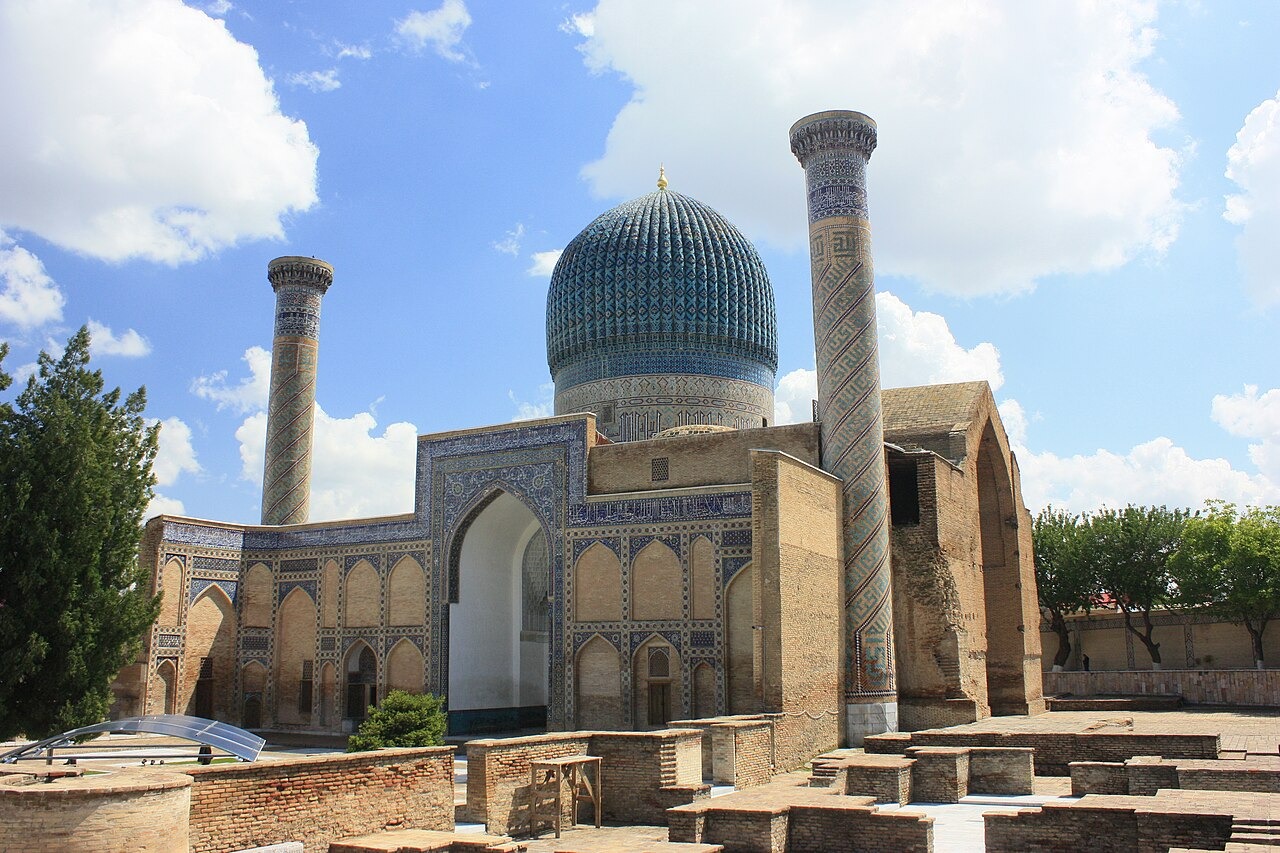
His father Turagay, the governor of Tashkent under the Chagatai State, loved the famous Naqshi shaykh Amir Kulal. Amir Kulal appointed his disciple Shams al Din Kulal as a tutor to Timur. From then on, scholars always held a position of honor in Timur’s life. In his magnificent mausoleum in Samarqand, at the head side lies his teacher Mir Sayyid Baraka, whom he never left; immediately in front of him lies Umar, the son of Amir Kulal.
The right side of Timur’s body was slightly paralyzed. Ibn Khaldun says that at short distances he walked dragging his foot, and at long distances his soldiers carried him on their shoulders in an object like a seat; Clavijo says that he traveled in a sedan chair. His right foot was disabled. The two little fingers of his right hand had also been severed. For this reason, especially his opponents called him "Timur the Lame". Indeed, when his grave was opened by the Soviets in 1941, a body 1.73 meters tall with a lame right leg was found. His skull was taken to Moscow and a bust was made accordingly. It is said that on the lid of his grave was written: “Whoever opens my grave will encounter an enemy more terrible than me.” The day after the excavation, Hitler attacked Russia.
The reason for this disability is as follows: Although Timur and his brother-in-law Husayn are described as equals, as Yazdi also accepts, the real authority was with Emir Husayn, and Timur was one of the commanders under him. When Emir Husayn lost his political struggle in Mawara al Nahr, he withdrew toward the regions of Sistan, taking Timur with him. Their condition was miserable. According to what Ibn Arabshah states directly and Timurid sources imply, they engaged in banditry there. They attacked caravans passing through that region and seized their goods, making their livelihood in this way. In a skirmish that broke out there, Timur was struck by an arrow in his kneecap and his leg remained crippled. His wound in the arm and the severing of the fingers on his hand were injuries from an armed struggle he had entered as a child. Foreigners who met Timur also say this. He may probably have engaged in banditry even as a child. Indeed, Timurid sources also say that in Sistan Timur was wounded only in his leg.
The Great Turkish Khaganate
At the age of 34, Emir Husayn became the ruler of Balkh. When his sister died, he and his brother-in-law Timur confronted one another. Because he married a lady descended from Genghis Khan, he became known as Gurgan (son-in-law of the khan). The marriage increased his prestige. Seeing himself as the heir of Genghis Khan, he sat on the throne of the Great Turkish Khaganate as the sovereign of all Turkestan.
Nevertheless, he restored the Muslim Turkish towns that Genghis had mercilessly burned and destroyed. Yet since he was not of Genghis’s lineage, he never used the title of khan. He kept his brother-in-law Sultan Mahmud with him as a symbolic khan. At the Battle of Ankara, this khan was the commander of one wing of the army.
When Tokhtamish, the khan of the Golden Horde whom he had initially supported, betrayed him, he marched against him and destroyed his state, which according to historians was Emir Timur’s greatest mistake. By this means the Russians were able to spread into these lands and establish a great state.
Emir Timur then marched into Anatolia. He showed mercy to those who surrendered; to those who did not, he showed no pity at all. He captured Sivas, which was defended by the sultan’s son; he burned and destroyed it. Then he turned south. Anatolia had a period of respite. The beys of the Anatolian principalities whose thrones had been taken away by Sultan Bayezid I sought refuge with Timur and provoked him against Sultan Bayezid I. Two rulers fleeing before Timur, Ahmad Jalayir and Kara Yusuf of the Qara Qoyunlu, took refuge with Sultan Bayezid I and incited the sultan against Emir Timur. The former Anatolian beys also went to Emir Timur and provoked him against the sultan. Timur came to Anatolia again.
The sultan underestimated Emir Timur, to whom the states of Byzantium, Trabzon Pontus, the Golden Horde, Egypt, and India were subject. He received his envoys coldly. However, Timur would have merely secured Anatolia’s allegiance and departed. The ulama (religious scholars) and the viziers urged the sultan toward peace. Yet Sultan Bayezid I, who had brought Europe to its knees, was not a man to yield. Nevertheless, the correspondence said to have been exchanged between the Sultan and Emir Timur has no basis in fact. (Shami, Zafarnama)
What a Pity
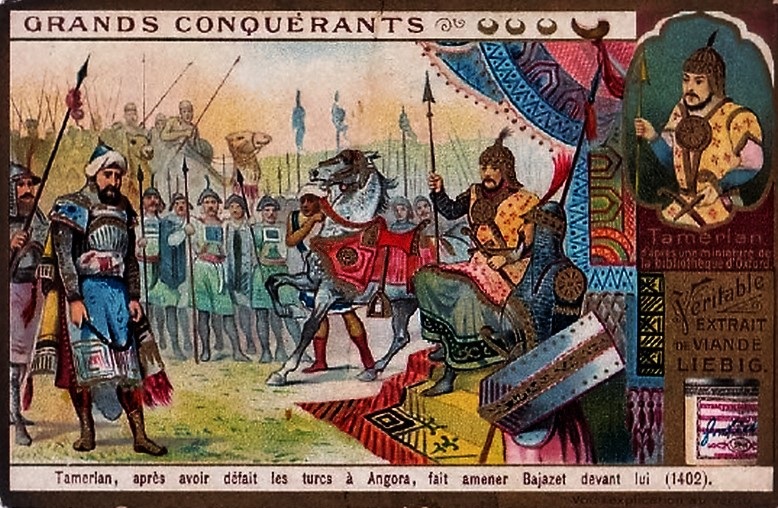
In Emir Timur’s army of 300,000 men, which had marched 6,000 km, there were all kinds of people. It is unjust to attribute all the oppression and cruelty committed during the war by so many soldiers, who were difficult to control and discipline, to Emir Timur. In 1402, one of the greatest pitched battles in history took place near Ankara. The Ottoman soldiers could not withstand an army twice their size and the elephants, but they were not annihilated. This defeat of the victor of Nicopolis struck terror into the rulers of Europe. They sent envoys and gifts, declaring friendship to Emir Timur. The Mamluk Sultan sent the famous historian and qadi Ibn Khaldun to Emir Timur to persuade him not to enter Egypt.
The sultan was taken captive together with his two sons Musa and Mustafa. Emir Timur treated the sultan and his family with respect. Timur took the sultan's daughters as wives for his sons. He took the sultan along wherever he went. This weighed heavily on the honor-conscious sultan. He requested a covered carriage for himself. It was accepted. Some later historians—among them the English writer Marlowe in his play titled Tamerlane—have said that for this reason Timur placed the sultan in a cage and paraded him about, which is not true. The sultan, who suffered from asthma, passed away in Akşehir out of grief. It is related that Emir Timur said, “What a pity! We have lost a great mujahid.”
Shahzade Suleyman, Isa, and Mehmed had escaped captivity with their soldiers. Shahzade Mehmed (Sultan Mehmed I in future) attempted to rescue his father but was unsuccessful. Bursa fell. The state treasury passed into enemy hands. A century-old state archive was burned. Emir Timur did not remain in Anatolia. He took Izmir from the Knights of Rhodes and returned. This is the one of the few battles Emir Timur fought against non-Muslims, whose “sword was always drenched in Muslim blood.”
The Ottomans’ subjection to the Timurids continued until 1447. What this victory gained for Emir Timur is unknown. But the unity of Anatolia suffered a great blow. Nevertheless, the Ottoman sultans who came afterward soon repaired the wounds of the disaster. Fifty years later, by conquering Istanbul, they established an empire.
Emir Timur passed away in 1405 while setting out on a campaign against China. Had he marched against China instead of Anatolia, the course of history would have changed. This would have meant the Islamization of China. Although his successors could not maintain his splendor after his death, from his lineage arose great rulers such as Ulugh Beg, Husayn Bayqara, and Babur. Babur conquered all of India and established there the Baburid Empire, which would live until 1858.
.jpg)
Timur Murd...
Emir Timur was a great ruler with his faults and merits. His capital Samarqand was the most splendid city in the world. Even now it is possible to see traces of this magnificence. His greatest service was, through his son Miranshah, having Fadlullah, the head of the Hurufi tariqa, eliminated. Some of his murids fled to Anatolia and took refuge in a Bektashi tekke. Even today, they play role in sustaining the opposisiton to Emir Timur. Ottoman historians also unjustly vilify him because of his struggle with Sultan Bayezid I.
He took pleasure in meeting scholars such as Sayyid Sharif Jurjani, Allama Taftazani, Firuzabadi, Hafiz Shirazi, Ibn Jazari, and Qutb al Din Izniki, and he showed them favor. In the hagiographies of awliya (spiritually enlightened people), Emir Timur is mentioned positively, likely because of his support for scholars, especially the people of tasawwuf (sufism).
Two centuries later, Imam Rabbani Ahmad Sirhindi, in his famous book Maktubat (vol. 2, letter 92), says: “While passing through Bukhara, seeing from afar many people shaking carpets, he curiously asked about it; when he understood that they were the carpets of the khanaqah of Khwaja Muhammad Baha al Din Bukhari, out of his great love and respect for Islam, he approached there and stood in the dust of the carpets, and as if anointing himself with musk and amber, he rubbed the dust of the khanaqah on his face and eyes, wishing to be honored with the spiritual effusion and blessings of those who are on the path of Allah. Because of the humility and abasement he showed to the friends of Allah, it is hoped that he was honored with husn al khatima (that he departed with faith at his last breath). According to what we have heard, when the news of Timur’s death was announced, one of the awliya of that time said in Persian, ‘Timur murd iman burd’ (Timur died. He took his faith with him).” In these expressions, there is a subtle allusion reminding Akbar Shah and his indifferent successor—who descended from him but showed hostility to religion—of their forefather’s respect for scholars, especially the Naqshbandis.
When he occupied Damascus, it is not true that he destroyed the tombs of Yazid and the Umayyads and that the soldiers defiled them. This is Shiite propaganda. In the Zafarnama of Nizam al Din Shami, who wrote his life by Timur’s own order, it says: While Timur was in Damascus, he visited the graves of Umm Salama, Umm Habiba, and Bilal al Habashi. When he saw that the graves were in ruins, he said, “Although they built such great buildings, mansions, gardens, orchards, and sky-reaching palaces for the sake of worldly desire, no man of zeal has arisen here to have even four walls built around the graves of the wives of the Prophet, upon him be peace, who are buried here—let alone having a dome or a mausoleum constructed out of motives of muruwwa (chivalrous virtue) or religiosity. If Allah does not afflict such a people with calamity, whom will He afflict?”
It is said that he was the historical figure most admired by Mustafa Kemal Atatürk. Indeed, he reportedly said that Timur was a valuable commander and a staff officer who applied the principles of fortification in the best manner. He examined all his battles from the strategic point of view and found them highly excellent. He expressed with appreciation that Timur, with a handful of forces in Central Asia, overthrew many governments and established a vast empire. He even had a play written about Timur, in which Timur was always the one speaking. When Afet Inan asked, “Pasha, in the play Timur always speaks. Will not the other characters speak?” he replied, “When Timur is present, can anyone else speak in front of him?” Atatürk was very curious about where the Battle of Ankara had taken place. He conducted much research to determine its location. Finally, one early morning he walked around the vicinity of Çubuk. He concluded that there was no more suitable place for a pitched battle than the location where today’s Esenboğa Airport stands. The Turkish government, showing great appreciation, gave the name of the Mongol commander Esenboğa, who defeated the Ottomans, to the capital’s airport.
One should read Emir Timur from two perspectives: from his official historian Yazdi, and from Arabshah, who lost his entire family in the invasion of Damascus. The events they recount are more or less the same; but the conclusions they reach and the expressions they use are entirely different. The work titled "Tamerlane: Sword of Islam, Conqueror of the World" by the English historian Justin Marozzi, also translated into Turkish, is among the most beneficial books that can be read on this subject.
Just as it was inappropriate for Emir Timur to crush Anatolia in pursuit of two commanders, it was equally mistaken for Sultan Bayezid I not to comprehend the power of such a world conqueror and to oppose him. Even if he would not return those who sought refuge with him, he could have expelled them; thus the great disaster might have been prevented. According to historians, Sultan Bayezid’s political genius was, unfortunately, not equal to his military skill. Nevertheless, it is difficult to pass judgment today on events of six centuries ago.
Önceki Yazılar
-
HE WAS TO BECOME SULTAN, YET HE DOES NOT EVEN HAVE A GRAVE: PRINCE ORHAN EFENDI23.09.2026
-
IS IMPRISONMENT A PUNISHMENT FOR THE CONVICT, OR FOR HIS INNOCENT FAMILY?16.09.2026
-
ABORTION AND INDUCED MISCARRIAGE IN HISTORY9.09.2026
-
EUROPE SHOULD LEARN TOLERANCE FROM THE EAST2.09.2026
-
A SULTAN IN THE GRIP OF THE MASONS: MURAD V26.08.2026
-
AN ANCIENT GREEK TRADITION AMONG CHRISTIANS: THE BETTER THE DOWRY, THE BETTER THE HUSBAND19.08.2026
-
WHY DID THE PROPHET MUHAMMAD MARRY MULTIPLE TIMES? Understanding the Prophet Muhammad’s Marital Life12.08.2026
-
HOLY RELICS ADORNING ISTANBUL5.08.2026
-
AN OTTOMAN PRINCE IN THE DESERTS OF LIBYA29.07.2026
-
THE TURKS AT THE GATES OF VIENNA22.07.2026