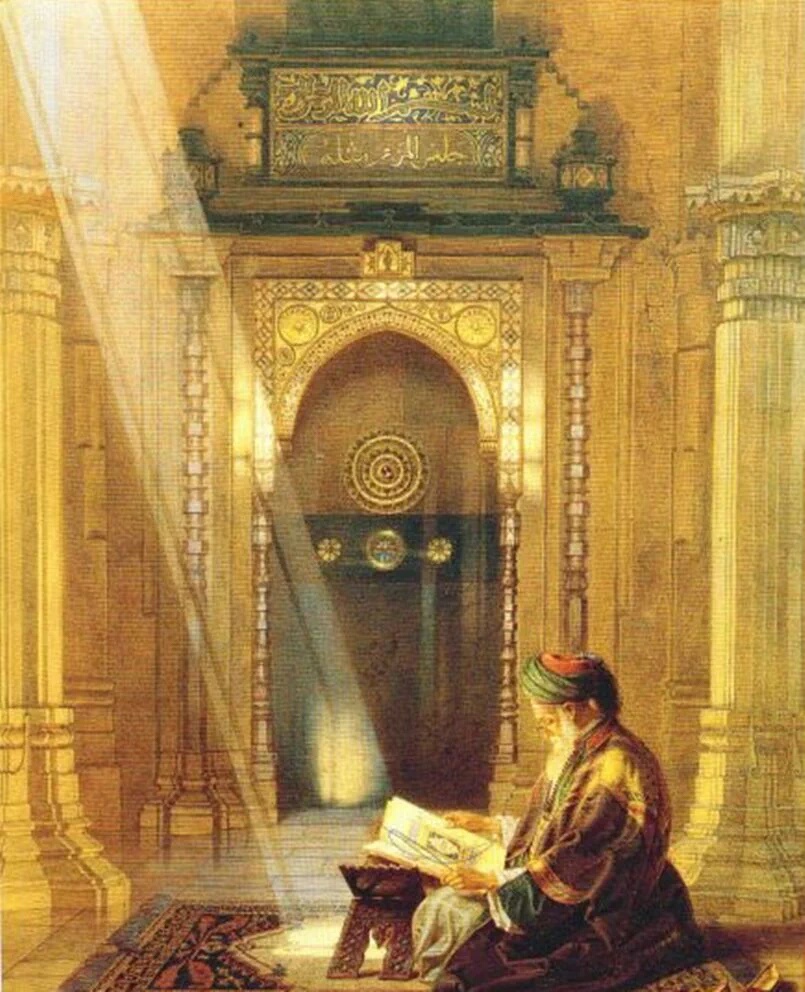
MEMORIZATION OF THE QURAN IS AN ANCIENT TRADITION
The archangel Jibril (Gabriel) would come once every year and recite the ayat (verses) of the Quran that had been revealed up to that time, and the Prophet Muhammad (peace be upon him) would repeat them.
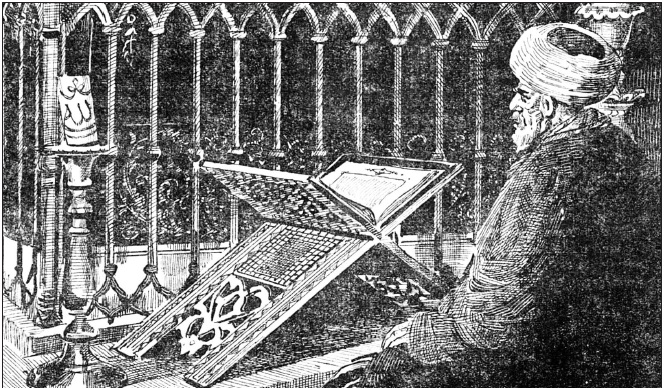
The elders would say, “The Quran al-karim was revealed in Hejaz; recited in Qahira; written in Istanbul.” Indeed, in Istanbul, including the sultans, many precious calligraphers produced exquisite mushafs (written copy of the Quran); likewise, the best huffaz (plural of hafiz, Quran memorizer) were mostly trained in Qahira. Khalil al-Hussary, whom the Turks recognized from Arab radio broadcasts, was known as the best among them. It is said that because their rib cages expanded from eating broad beans, Egyptians are inclined to produce huffaz with high-pitched voices and broad breath.
Since the time of the Ottomans, it was customary for Egyptian huffaz to come to Türkiye during Ramadan and display their skill in the great mosques before the tarawih prayer. On one occasion, as we exited the mosque side by side, I overheard the hafiz say, “Whatever we did, we could not please the Turks.” In Arab countries, it is customary that when huffaz who recite the Quran al-karim with a moving voice pause in between, the congregation shouts praise phrases such as “barakallah, hayyakallah” in a tone of appreciation. How could the hafiz know? He must have expected such applause. Among us, it is customary to listen to the Quran al-karim with seriousness and deep silence. I remember that I could not endure it and apologized to him by explaining this. However skillful some Egyptian huffaz may be, they are somewhat distant from appealing to our ears. For the method of qiraat differs between the two countries.
One Teacher for Every Town
One who knows the Quran al-karim by heart is called a qari. Among us, he is mistakenly called a hafiz. Hafiz is one who knows a great number of hadith al-sharif by heart. Since such people no longer remain, qari are now called hafiz. As the Quran al-karim was being revealed, the Sahaba (companions of the Prophet), together with the Prophet Muhammad, would memorize all or part of it. One had memorized what another had not. There was almost no one who did not memorize. The archangel Jibril would come once every year and recite the ayat of the Quran that had been revealed up to that time, and the Prophet Muhammad would repeat them. This is called al-arda (presentation). It is the basis of our muqabala tradition (reading the Quran together). In the year the Prophet would pass away, Jibril came twice. The divine text was thus finalized. The Prophet Muhammad understood from this that he would pass away that year.
The Prophet Muhammad would send teachers to every town to teach the Quran al-karim. Caliph ‘Umar would increase the shares of war booty in proportion to how much of the Quran al-karim one had memorized. Caliph Uthman established schools of the Quran al-karim. The Sahaba taught the Quran al-karim to new Muslims wherever they went. Muslim governments, including the Ottomans, attached importance to the science of qiraat (approved ways of reciting the Quran) and to training huffaz. For this purpose, they established higher schools called Dar al-kurra. Because the presence of one hafiz in a town is an obligation upon all Muslims. It is known that the blind are more capable in this matter. Especially in Arab countries, many blind huffaz continuously recite and teach the Quran in mosques and make their living in this way.
The Egyptian qiraat tradition weakened with the reformist activities of the Egyptian mufti Abduh; with the rise to power of socialists like Nasir, it declined even further. In time, under the influence of Wahhabism, which claimed to restore religion to its original form, a spiritless form of qiraat spread. In Egypt as well as throughout the entire Islamic world, memorization of the Quran and recitation with tartil (beautiful voice and harmony) fell out of favor. In Türkiye, the resistance of the district of “Trabzon, Of” to this trend is praiseworthy. The late Bayezid Mosque imam Abdurrahman Gurses was the shaykh al-kurra (chief authority in Quranic recitation) of our time. We could never tire of listening to him.
Every Companion Has a Style
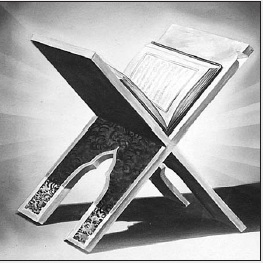
The Quran al-karim, in its entirety, has been transmitted by tawatur (a form of transmission so widely reported that collusion upon falsehood is considered impossible) from the Prophet Muhammad through a community whose agreement upon a lie is impossible. However, regarding the recitation of some ayat and the pronunciation of certain letters, there are some variant narrations unanimously transmitted from the Prophet Muhammad that do not significantly affect the meaning. These are seven in number and are known as qiraat al-saba. These are the recitations of Nafi, Ibn Kathir, Abu al-Amr, Ibn Amir, Asim, Hamza and Kisai. In accordance with the tradition in the hadith al-sharif stating, “The Quran al-karim was revealed upon seven letters,” they were called seven qiraat. Otherwise, the seven letters mentioned there are not related to qiraat here; they indicate that in the early period some ayat could be recited according to seven dialects of Arabic.
Apart from these, there are three more qiraat which some scholars hold to have also been transmitted by tawatur. These are the recitations of Abu Jafar, Yaqub and Abu Muhammad. Thus, all of them together are called qiraat al-ashara. Apart from these, there are three more qiraat, namely those of Basri, Ibn Muhaysin and Amesh. These are shadh qiraat, and since they were not transmitted through strong chains, their recitation in prayer is not permissible. Each of the imams of qiraat belonged to the Tabiin or the Taba al-Tabiin. They learned qiraat from the Sahaba or the Tabiin and received ijaza.
Three quarters of the world’s Muslims, including Türkiye, recite the Quran al-karim according to the riwaya of Hafs from the qiraat of Imam Asim, and they write their mushafs accordingly. The Iraqi Imam Asim learned qiraat from the Sahaba. He was blind. He died in 745. Imam Hafs was among his leading students. In Northwest Africa (Morocco, Tunisia, Algeria) and in part of Egypt, the riwaya of Warsh from the qiraat of Imam Nafi is widespread. In part of Africa (for example, in Sudan), the Quran al-karim is recited according to the qiraat of Imam Abu Amr.
For example, in Surah al-Baqara, verse 265, the word rabwa, which means an elevated place through which rivers do not flow, was read as rubwa by Ibn Kathir, Hamza, Kisai, Nafi and Abu Amr; as rabwa by Asim, Ibn Amir and Hasan; as ribwa by Ibn Abbas and Abu Ishaq al-Sebii; as rebawa by Abu Jafar and Abu Abdurrahman; and as ribawa by Eshab al-Akili.
Önceki Yazılar
-
ABORTION AND INDUCED MISCARRIAGE IN HISTORY9.09.2026
-
EUROPE SHOULD LEARN TOLERANCE FROM THE EAST2.09.2026
-
A SULTAN IN THE GRIP OF THE MASONS: MURAD V26.08.2026
-
AN ANCIENT GREEK TRADITION AMONG CHRISTIANS: THE BETTER THE DOWRY, THE BETTER THE HUSBAND19.08.2026
-
WHY DID THE PROPHET MUHAMMAD MARRY MULTIPLE TIMES? Understanding the Prophet Muhammad’s Marital Life12.08.2026
-
HOLY RELICS ADORNING ISTANBUL5.08.2026
-
AN OTTOMAN PRINCE IN THE DESERTS OF LIBYA29.07.2026
-
THE TURKS AT THE GATES OF VIENNA22.07.2026
-
THE SOLE FEMALE RULER OF TURKISH-ISLAMIC HISTORY15.07.2026
-
SIYASATNAMAS: THE FORGOTTEN SCHOOLS OF POLITICS8.07.2026