A DAY IN THE LIFE OF AN OTTOMAN SULTAN
The sultan would rise before sunrise. If necessary, after bathing and performing ablution, he would generally perform the morning prayer in congregation with the Enderun aghas (Palace officers) at the Aghas' Mosque. After the prayer, he would read the Quran al-karim and engage in dhikr (the remembrance of Allah).
The obligation to perform the prayers regularly was observed in the Ottoman palace to the very end. As in society at large, daily life was arranged and organized according to prayer times. Life in the palace proceeded with solemnity. The image of a sultan having jariya (female slave-concubine) dance beside a pool was invented by foreign painters.

Dining Alone
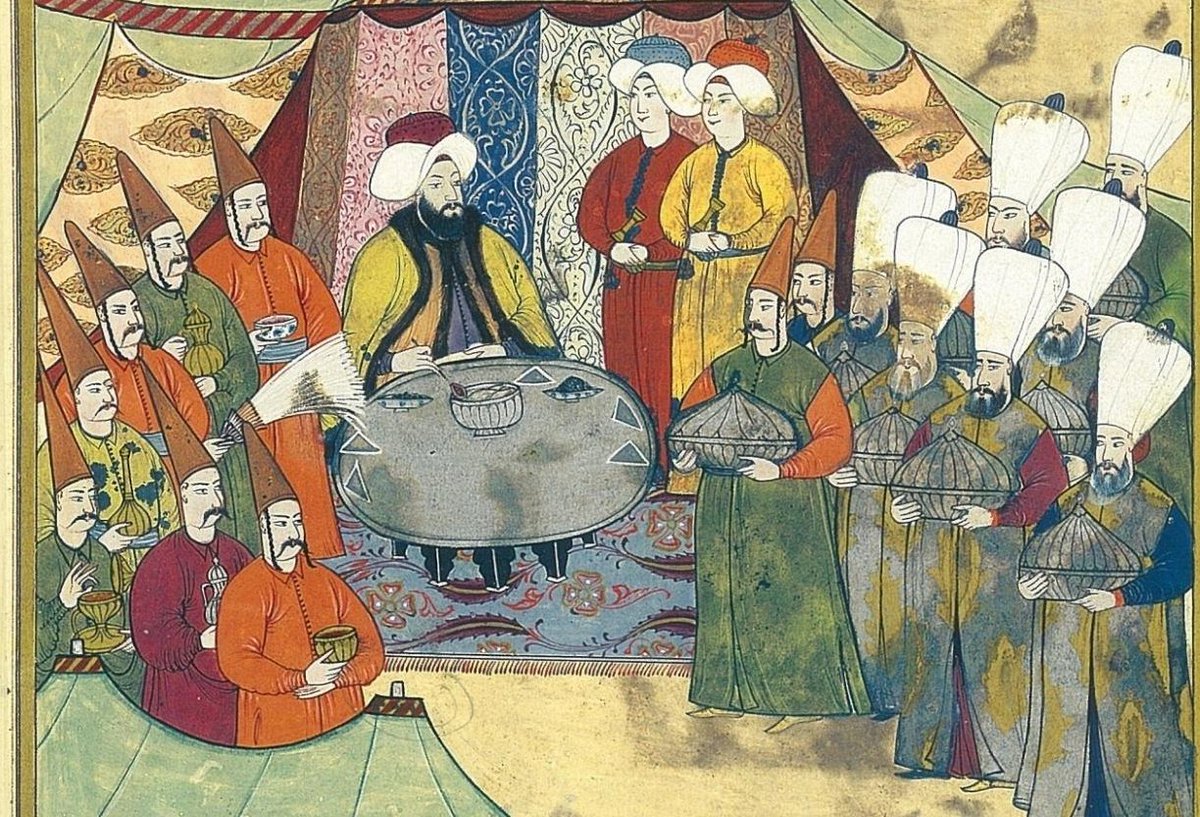
Breakfast was prepared in the pantry room of the inner palace, known as the Enderun, under the supervision of the chief pantry officer. The chief taster would present it on a serving tray. The sultan would sit on the floor and eat at a low dining table, with the food placed on a large round metal tray. He would spread a napkin over his knees and hang another from his left arm.
In the early times, sultans, like everyone else, ate twice a day. One meal was eaten at “kuşluk vakti” (midmorning), at roughly one-quarter of the way through the day, that is, around nine or ten o'clock. The other was eaten after the afternoon prayer.
Before that, small children and frail elderly people who could not endure hunger until midmorning were given a light breakfast consisting of bread and cheese at around eight o'clock, known as “kaba kuşluk vakti” (early midmorning).

Mealtimes were announced by the playing of the mehter band. In earlier times, the sovereign and senior state officials would first listen to the mehter standing respectfully, then sit down and eat together.
From the reign of Sultan Mehmed II onward, the custom of eating three times a day—morning, noon, and evening—became established. On the long days of summer, meals were sometimes served four times a day.
Furthermore, after Sultan Mehmed II, the sultans always ate their meals alone. After the Tanzimat reforms, they occasionally ate with family members or guests and also attended invitations.
A sultan's breakfast generally included the following: special-quality bread, warm milk, butter, honey, jam, eggs cooked according to preference, cheese, cold meat, börek (filled pastry), and fruit. Tea had not yet become part of daily life. Sherbet (sweetened fruit drinks), served hot or cold, and milk were consumed.

The First Half of the Day
The sultan's daily life was spent between the harem and the Enderun, that is, within the inner palace. The harem, also known as Darussaade, was where the sultan lived with his family; in other words, it was his home. After breakfast, the sultan would leave the harem quarters and go to his office in the Enderun, known as the Has Oda (Privy Chamber).
There, he would spend time with the aghas, each of whom possessed a particular skill or accomplishment and was an Ottoman intellectual in his own right. He would attend to affairs of the empire, read the documents submitted to him, and dictate his writings. After the Tanzimat reforms, this section became known as the Mabeyn (the imperial apartments connecting the sultan's private quarters with the administrative offices).
The sultan presided over the Divan-i Humayun (Imperial Council), which convened in the palace. From the reign of Sultan Mehmed II onward, he no longer attended its meetings in person but followed the deliberations from a screened box reserved for him.
When the meeting ended, the members of the council would appear before the sultan in turn in the Arz Odasi (Chamber of Petitions), directly opposite the entrance to the palace's third gate, known as the Babussade (Gate of Felicity). They would present the matters they had discussed and obtain his approval.
At other times, it was not customary for grand viziers to come to the palace unless summoned by the sultan. Ambassadors and guests were also received in this magnificent chamber.
On days when the council did not meet, if the weather was warm, the sultan would sometimes go horseback riding or take a boat to one of the gardens and pavilions along the shores of the Sea of Marmara, the Bosphorus, or the Golden Horn. Some sultans traveled by ship to nearby cities.
He would engage in hunting or other sports and watch sporting competitions among the Enderun residents. The palace also had various pavilions where he could rest and drink coffee.
Sometimes, he would disguise himself by changing his clothes and go out to walk around the city, accompanied by a trusted individual. He would learn about the people's circumstances and take the pulse of society.

World Cuisine
On Fridays, the sultan would attend the Friday imperial procession, known as Cuma Selamlığı. After performing the prayer at one of the mosques, he would return to the palace. On other days, lunch was eaten after the prayer performed at the Aghas' Mosque.
This meal was prepared in a special palace kitchen known as the Kuşhane (literally meaning "birdhouse" but historically referencing a birdcage-like private structure). Cooks called kuşçu, belonging to the Zülüflü Baltacılar corps (palace guards at Topkapi Palace who wore special headgear and high-collared garments to avoid accidentally seeing the women of the Imperial Harem), which maintained the connection between the harem and the outside world, would cook the food in copper serving dishes, under the supervision of the taster (çeşnigir).
The food was placed in covered serving dishes, arranged on a tray, and wrapped in a tulle cloth. After the dishes had been sealed, they were presented to the sultan by tray bearers under the supervision of the chief tray bearer.
If the meal was eaten in the Enderun, the tasters and members of the pantry staff would serve it; if it was eaten in the harem, the senior jariyas assigned to permanent service would attend to him.
The food was presented to the sultan on plates specially manufactured from Chinese porcelain. If the food was poisoned, the decorations on these plates would immediately change color, revealing the situation.
Lunch included the following: soup, kebab, chicken or turkey, meat and vegetable dishes, dolma (stuffed vegetables or leaves), pilaf, muhallebi (milk pudding) or sütlaç (rice pudding), okra cooked with a sour sauce, game meat, dried vegetables, börek, baklava or another pastry dessert, fruit, and sherbet. Pickles to stimulate the appetite were also served at the table. The Kuşhane's musk-scented ashura (a traditional pudding made from grains, legumes, and dried fruits) was famous.
Dishes cooked with olive oil and fish were neither prepared nor eaten in the palace because they gave off unpleasant smells while cooking. Alcoholic beverages were never allowed into the palace.
Even during the reign of Sultan Mehmed II, sultans ate simple meals. The tables became more lavish after the eighteenth century, when Ottoman cuisine gained international renown. Nevertheless, a sultan preferred to eat a small number of dishes in modest portions at any one meal.
During Ramadan, meal times and eating habits changed because everyone fasted.

The Second Half of the Day
After lunch, the sovereign would retire to rest. Sometimes, during this time, he would read books or attend to personal pursuits such as poetry or calligraphy. The Enderun had a palace library containing nearly five thousand highly valuable works. The library at Yıldız Palace held ten thousand volumes.
After the afternoon prayer, he would again leave the harem and go to the Enderun (the Mabeyn). Until the evening prayer, he would meet with people of his choosing. These were generally different individuals on different days of the week, including religious scholars, men of learning, experienced former senior state officials, poets, literary figures, and artists.
Sultan Abdulhamid II would spend these hours working in his carpentry workshop or walking in the garden. It was not unusual for him to remain at the Mabeyn working until late at night.
After the evening prayer, the sovereign would eat a lighter meal than the one served at noon. Until the night prayer, he would occupy himself with his own pursuits. If his mother, the Valide Sultan, was still alive, he would often meet with her during this time. After the night prayer, he would withdraw to the harem and his bedroom.

Seclusion
Treasurers' attendants would keep watch outside the bedroom until morning. These women were among the most trusted in the harem and could enter and leave the sultan's presence at any time. Even his own family was denied this privilege.
The treasurers' attendants would dress the sultans. Over an undershirt and shalwar, he would wear a traditional three-skirted Turkish robe and wrap a sash around his waist. Over this, he would wear a sleeveless kaftan or a fur-lined robe. His clothes were simple yet extraordinarily elegant. The fabrics were Turkish-made. He would wrap a light turban around a skullcap. On ceremonial occasions, he would wear a kavuk (a traditional Ottoman turban-style headdress). On his feet, he would wear lightweight Morocco-leather slippers shaped like indoor boots.
After Sultan Mahmud, the sultan would wear loose trousers and an Istanbulin (a long, buttoned-up Ottoman frock coat with a high collar), and put on fotin (ankle-high boots). He would cover his head with a fez. When going outside, he would put on a harmani (cloak) or an overcoat. He would sometimes wear a uniform as well.
On some evenings, he would watch entertainment organized by the girls' band in the harem. During the Tanzimat period, a palace theater was built, where performances were staged for the palace residents. The sultan sometimes attended these performances, and foreign guests were occasionally invited for diplomatic purposes. Sultan Abdulhamid II had the habit of having someone read books to him at bedtime.
It was customary for the sultan to send a gift during the day to the haseki (his consort) with whom he would spend the night. The haseki who received the gift would be taken to the bathhouse and bathed. She would be perfumed with fragrant scents, dressed, and adorned. She would then be taken to the sultan's apartments. After the kizlar agha (chief black eunuch) had obtained the necessary permission, he would escort her through the door into the sultan's presence.

Privy Secretary, Take This Down!
Apart from the visit to the Khirqa al-Sa‘ada (the Blessed Mantle of the Prophet Muhammad) during Ramadan, mawlid recitations commemorating the Prophet's birth were held on the holy nights, and the sultan would participate.
On religious festivals, a muayede (ceremony of exchanging festival greetings) would take place. The sultan would first exchange greetings with senior state officials in the palace and then with his family in the harem.
When a foreign guest arrived, special programs could be arranged accordingly.
The sultans' daily activities were recorded by their privy secretaries in ruznames (daily journals). Those belonging to Sultan Mahmud I, Sultan Osman III, Sultan Mustafa III, Sultan Abdulhamid I, and Sultan Mahmud II—that is, the sultans of the eighteenth century—have survived to the present day.
Önceki Yazılar
-
THE LUXURY OF WAGING WAR AGAINST A POWERFUL ENEMY4.11.2026
-
IF THE PALACE CANNOT TEACH YOU MANNERS, NOWHERE CAN! THE HEART OF THE STATE, THE MIRROR OF THE EMPIRE28.10.2026
-
POLITICAL POWER AND ITS INNER CIRCLES THROUGHOUT HISTORY21.10.2026
-
THE LAST EMPEROR’S SORROWFUL DAYS IN SAN REMO14.10.2026
-
WHO WAS THE OTTOMAN JUDGE?7.10.2026
-
“IF YOU REALIZE THAT YOU ARE WRONG, DO NOT HESITATE TO RETURN TO WHAT IS RIGHT!”30.09.2026
-
HE WAS TO BECOME SULTAN, YET HE DOES NOT EVEN HAVE A GRAVE: PRINCE ORHAN EFENDI23.09.2026
-
IS IMPRISONMENT A PUNISHMENT FOR THE CONVICT, OR FOR HIS INNOCENT FAMILY?16.09.2026
-
ABORTION AND INDUCED MISCARRIAGE IN HISTORY9.09.2026
-
EUROPE SHOULD LEARN TOLERANCE FROM THE EAST2.09.2026