.jpg)
ABORTION AND INDUCED MISCARRIAGE IN HISTORY
Years ago, I went to Finland. Everywhere, there were posters of mothers holding beautiful children in their arms. They looked like advertisements for baby food or baby powder. I asked about it and learned that the country’s population was declining and ageing. The government was carrying out such campaigns to encourage population growth. I was surprised, because at that time everyone in Türkiye was complaining about population growth. Population, especially a young population, is indeed a source of strength for a country. The famous political philosopher Jean Bodin says, “Power lies in population.” One of the reasons given for the decline of the Ottoman State is also its small population. Economists say that population growth, particularly growth in the young population, plays an important role in revitalising economies that are in decline.

The Greater the Number of Believers, the Better
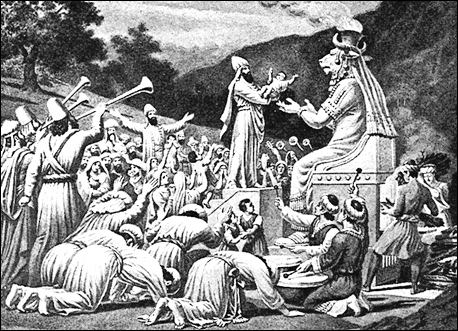
Unlike the practices in Greece and Rome, where a father could freely kill his child before or after birth, the Abrahamic religions desire an abundance of believers; correspondingly, they do not permit induced miscarriage. The Torah condemns Onan, who practised birth control. On the other hand, according to the Torah, a person who causes a miscarriage pays compensation to the father. Until relatively recently, causing a miscarriage in Israel was a crime punishable by imprisonment, and married women between the ages of 17 and 40 were generally not permitted to have abortions.
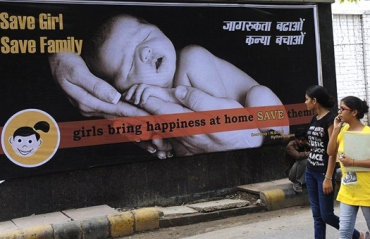
The Church remains strongly opposed to birth control and abortion even today. Knowingly causing an abortion is grounds for excommunication (expulsion from the religion). Among Hindus, a woman who causes a miscarriage is expelled from her caste. Nevertheless, the rate of abortion of female children in India is astonishingly high. For this reason, abortion has been legal since 1972; however, learning the sex of the fetus by ultrasound is prohibited. Since 1981, large numbers of abortions were carried out in China under the compulsory one-child policy. Today, however, China is facing a serious population crisis as its birth rate continues to fall and its population ages rapidly.
The Turkish word kürtaj (abortion) comes from the French curetage, a medical term meaning the cleaning or scraping out of a body cavity, particularly the uterus. The French word is related to curer, “to clean” or “to scrape,” which ultimately derives from the Latin curare. The same root can be seen in the French cure-dent, meaning “tooth-cleaner,” which entered Turkish as kürdan (toothpick).
The first country to legalise abortion was Soviet Russia in 1920. Sweden and Denmark followed in the 1930s. In reaction to this, although abortion was officially prohibited in Britain and America, the American Supreme Court opened the way for abortion in 1973 by annulling the states’ right to prohibit it. Abortion remains a powerful argument in the struggle between right-wing and left-wing parties in America and Europe. It comes onto the agenda during every election cycle; a referendum is held in at least one state.
Today, abortion laws vary considerably around the world. In the United States, abortion is legal in some states but heavily restricted or prohibited in others, while Canada and South Africa permit abortion subject to statutory limits. In Europe, most countries permit abortion within specified gestational limits, generally ranging from 10 to 24 weeks, while Malta and Poland, where Catholicism is strong, maintain particularly restrictive laws. Australia permits abortion in all states and territories, although the limits vary. Globally, abortion remains restricted or prohibited in many countries, including several in Latin America, Africa and Asia. Among Muslim-majority countries, Tunisia and Türkiye have some of the most liberal abortion laws.



Punishment for Causing a Miscarriage
Islam recommends that believers increase in number. The hadith “Marry and multiply! I shall take pride in the multitude of my community on the Day of Judgment” demonstrates this. Nevertheless, there is no need to say that quality is more important than quantity and that a qualified increase in population is desired. Causing an unjustified miscarriage and abortion are prohibited. Thus, the Quran al-karim says, “Do not kill your children for fear of poverty. I provide sustenance for them and for you. Surely, killing them is a great crime” (Surah al-Isra 31). Although the verse is general concerning the killing of children, it has also been regarded as encompassing deliberately causing a miscarriage.
There is permission to cause a miscarriage at the beginning of pregnancy for an important reason, such as a threat to the mother’s health or fear that she will be unable to provide religious upbringing. The relevant period is 120 days. Indeed, the Prophet Muhammad (peace be upon him) said, “The spirit is breathed into the child in the mother’s womb when it is 120 days old.” Among the Malikis, this period is 40 days. Here, the mother’s consent is important. If the woman does not want it, she cannot be forced to have an abortion. Nevertheless, there are scholars who do not permit induced miscarriage at all. Qadihan says: “Hunting while in ihram during the pilgrimage is blameworthy. Breaking the egg of a game animal is subject to the same ruling, for the egg is the beginning of the animal’s life. If even this incurs a penalty, then, at the very least, a woman who causes a miscarriage without a valid excuse is considered to have committed a sin.” In 1998, by a fatwa issued in Egypt and a court ruling issued in Algeria, women who had become pregnant through rape were not considered to have committed a crime by having an abortion.
Human legal personality begins at birth. If a child in the mother’s womb is born dead as a result of an external intervention such as a blow or abortion, this is also considered legally a birth. The child is considered to have been born alive and then to have died. Isqat al-janin, that is, causing a miscarriage, is a crime according to Ottoman law. A person who causes a pregnant woman to miscarry her child by striking her intentionally or unintentionally, or by means of medicine, pays one-twentieth of the normal human blood-money as a penalty. This is called ghurra. A ghurra is 500 silver dirhams. If the limbs of the miscarried child have not yet become distinguishable, a ghurra is not required. However, the perpetrator may be subjected to tazir punishment, a discretionary punishment determined by the judge. A woman who causes or has an abortion without her husband’s permission also pays a ghurra to the heirs of the child (for example, the father). If the child is born alive and then dies, full blood-money is paid. According to the Shafii and Hanbali schools, it is also obligatory for the killer to perform kaffara, that is, to emancipate a slave; if this is not possible, he must fast for 60 days. According to the Malikis, if the child was deliberately caused to miscarry, retaliation (qisas) may even be decreed.
The Development of the Country Depends on Population
In the Ottoman Empire, it was thought that the population shortage caused by wars and epidemics would bring disaster; from time to time, the prohibition against causing miscarriages was reiterated. Particularly during the reigns of Sultan Selim III and Mahmud II, many imperial decrees and orders on this matter can be found. An imperial decree dated 1838 also says, “The development and security of the country depend on the increase of the population. Causing a miscarriage is rebellion against the divine will. It also endangers the mother’s health.”
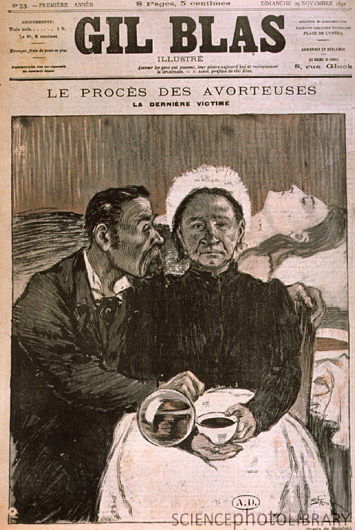
Apart from doctors, pharmacists and midwives, some Jewish women, generally in out-of-the-way places, would assist in this matter; as a result of interventions carried out under primitive conditions, the mother would often lose her life as well. Such midwives, known as “bloody midwives,” were apprehended and exiled. Women who could not find such a midwife would attempt to cause a miscarriage by their own means: by inserting knitting needles, goose feathers, etc.; by lifting heavy objects; by jumping from heights; by inserting things such as vinegar-soaked cloths, soap suppositories and the sulphur from the tip of a match into the womb; by grinding black juniper bush leaves into powder while they were still young shoots and drinking them; and by boiling and drinking ivy and comfrey (Symphytum). In addition, those who had more than five children or triplets in a single birth were reported to the government by the neighbourhood imam; assistance was provided to these families. Efforts were made to prevent childhood diseases; severe punishments were imposed on those who kidnapped children.

The Ottoman Penal Code of 1858 states that, regardless of when it occurs, those who cause a miscarriage, whether or not the mother consents, shall, in addition to paying blood-money, be sentenced to hard labour if they acted intentionally. The French Penal Code of 1810 also introduced severe imprisonment and hard-labour penalties. Measures were also taken to increase the population during the early years of the Turkish Republic. Abortion was strictly monitored; taxing unmarried people was considered; those with five children were exempted from the road tax, a tax imposed to help finance road construction. The Turkish Penal Code regarded causing a miscarriage as a serious crime. It imposed 5–10 years of imprisonment on those who caused a miscarriage without the mother’s consent. In time, the situation was reversed; following the September 12 coup leaders’ population-planning policy, abortion was permitted up to 10 weeks with the mother’s consent. A woman who became pregnant through rape may have an abortion up to 20 weeks.

Who Is Guilty?
In the early years of the Turkish Republic, gendarmes who received a tip-off about smuggled tobacco raided an Anatolian town. While the villagers kept the gendarmes occupied, they also burned the smuggled tobacco. The suspicious gendarmes fired into the air; the enraged people then beat the gendarmes, saying something along the lines of “enough is enough.” In those days, no one dared to show any disrespect to a civil servant or a gendarme. The district governor went mad with rage. He told the investigating judge, who was a native of the town, about the gravity of the matter. “Now let the townspeople choose which death they prefer,” he said. The investigating judge was shrewd. To save the people, he resorted to a ruse: “Mr. District Governor, our people are not the sort of people who would do such a thing. But when the gendarmes started firing here and there, a few frightened women suffered miscarriages. The people became enraged by this.” This time, it was the district governor’s turn to become worried. For it was a time when measures were being taken to increase the population. Causing a miscarriage was a serious crime. “Please, Mr. Investigating Judge, I’ll be ruined; save me!” he began to plead. He replied, “Don’t worry, Mr. District Governor, I’ll take care of it!” The matter was covered up.
Önceki Yazılar
-
THE LAST EMPEROR’S SORROWFUL DAYS IN SAN REMO14.10.2026
-
WHO WAS THE OTTOMAN JUDGE?7.10.2026
-
“IF YOU REALIZE THAT YOU ARE WRONG, DO NOT HESITATE TO RETURN TO WHAT IS RIGHT!”30.09.2026
-
HE WAS TO BECOME SULTAN, YET HE DOES NOT EVEN HAVE A GRAVE: PRINCE ORHAN EFENDI23.09.2026
-
IS IMPRISONMENT A PUNISHMENT FOR THE CONVICT, OR FOR HIS INNOCENT FAMILY?16.09.2026
-
EUROPE SHOULD LEARN TOLERANCE FROM THE EAST2.09.2026
-
A SULTAN IN THE GRIP OF THE MASONS: MURAD V26.08.2026
-
AN ANCIENT GREEK TRADITION AMONG CHRISTIANS: THE BETTER THE DOWRY, THE BETTER THE HUSBAND19.08.2026
-
WHY DID THE PROPHET MUHAMMAD MARRY MULTIPLE TIMES? Understanding the Prophet Muhammad’s Marital Life12.08.2026
-
HOLY RELICS ADORNING ISTANBUL5.08.2026