.jpg)
Urban Dwellers, Peasants, and Nomads in the Ottoman Empire: TURKS ARE A NOMADIC PEOPLE, AFTER ALL
A part of the Ottoman population lived in cities; the majority, however, lived in villages. Another part led a nomadic life. Their statuses were not the same.
Urban dwellers were either from the military class, that is, they were officials; or they were artisans and tradesmen. An Ottoman city was a settlement center governed by its own specific rules. Its civil administrator was, depending on its size, a beylerbey (provincial governor), a sanjak-bey (district governor), or a qadi (judge). There were also officials who acted as their assistants and dealt with municipal and security affairs. In the early times, cities were surrounded by a fortress for security. Later, as the population grew, houses spread to the base of the fortress, and suburbs began to emerge.

Jews Were Not Peasants
In order to ensure security and provisioning, that is supply of basic necessities, in a stable manner, the population of cities was kept fixed. Not everyone was allowed to come and settle in the city as they pleased. A peasant could not easily abandon the land he had undertaken to cultivate. From the end of the 16th century onwards, due to the Jelali Revolts and the Persian Wars, peasants settled in nearby cities. Thus, in cities, a mass of unemployed, poor, and hopeless people emerged. The order of security and provisioning was disrupted.
The people in villages were engaged in agriculture. They farmed by leasing state-owned land from a timarli sipahi (timariot cavalryman). In villages where an imam-khatib was appointed by an imperial decree to lead Friday prayers, this imam-khatib was the representative of the government. The same applied in quarters. For he was the most educated among the people. Official orders were sent to village imams to be conveyed to the public. The qualifications of those who testified in court were also asked of the imams. Sultan Mahmud II established the institution of mukhtars (local headmen) in villages and quarters. Imams took part in the council of elders.
Since Ottoman Armenians were artisans, Armenians came and settled in every newly established city in proportion to need. Rums (Greek Orthodox Christians) were also engaged in trade. There were also villages inhabited by Armenians and Greeks. But Jews were always urban.
.jpg)
Turks Are a Nomadic People, After All
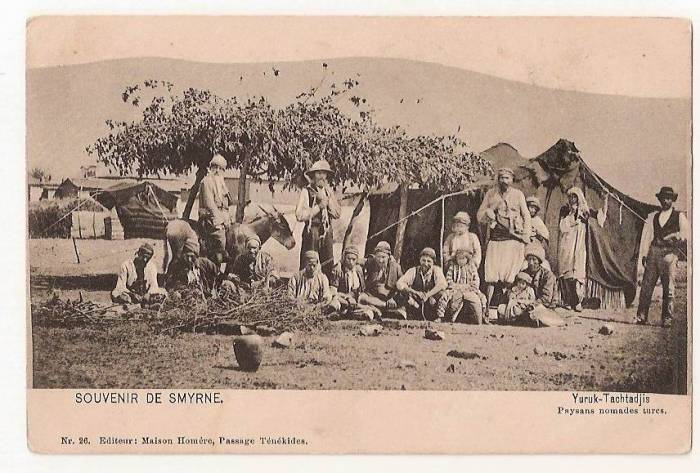
A part of the Ottoman population had long lived a nomadic life. Raising sheep; organizing life accordingly; in short, migrating with ease is an ancient Turkish tradition. In Shajara-i Tarakima (genealogy of the Turkmens), it says: “Is there any road that the Oghuz people have not traveled by migrating? Is there any place where they have not pitched their homes and settled?” This way of life is also common among Arabs and Kurds. Just as Arab nomads are called arabi (bedouin), Turkish nomads are called yuruk, from the Turkish verb “to walk.” Settled peasants are called Turk, while those who lead a semi-nomadic life are called Turkmen.
Nomads live in warm places in winter; and in summer they migrate to cool regions rich in pasture. They do not have fixed villages or houses; they live in tents. They generally raise sheep; and migrate with camels and horses. They live in kıl çadır (black goat-hair tent), alacık (small tents made of reeds), or topakev. A topakev is a dome-shaped tent built on a wooden frame, typically of pine, and covered with felt. It is detailed and magnificent; yet practical to assemble and dismantle. It does not let in cold in winter or heat in summer.
A large number of nomadic Turks live in Syria, Iraq, and even Palestine. In spring, they dismantle their black tents, alacık, and topakev; load them onto camels or horses; and with their sheep and goats in front of them and their dogs beside them, they set out northward. Walking hundreds of kilometers, they reach the cool pastures of Central Anatolia. They spend the summer there. In autumn, they set out on the return journey. This event is repeated every year. The nomadic character of the Turks still manifests itself even today.

A Tax-Free Life
The Ottoman State preferred to settle nomadic Turkmens in newly conquered lands. Governments do not look favorably upon nomadism. The migration of thousands of people naturally harms those living along the migration routes and disrupts public order. Nomads do not pay taxes and do not perform military service. They are deprived of civilized life. Moreover, their religious life remains limited due to a lack of knowledge.
From the 15th century onwards, nomads were incorporated into a formal administrative framework. Taxes and various obligations were imposed upon them. The government appointed a literate member of their community as kethuda (steward), through whom it conducted its official affairs. From the end of the 16th century onwards, in order to obtain regular soldiers and taxes; to develop agriculture; to repopulate deserted villages; and to prevent the damage they caused along migration routes, the government attempted to settle nomads in empty villages in Anatolia.
Especially during the Tulip Era, widespread settlement activity is observed in Anatolia. Nomads, who did not want to abandon their accustomed way of life, resisted this strongly. But they could do nothing. From the end of the 18th century onwards, it was largely successful. Especially Central Anatolia was settled with these nomads. They continued their nomadic life by residing in villages and towns in winter and moving to nearby highlands in summer.
Who Led in Urbanism?
There is a current of urbanism in Anatolia that began with Alexander the Great. The second current began with the arrival of the Seljuks in Anatolia. Whatever existed here in the name of cities and towns, whatever was done in the name of construction and development, all date from this period. As can be understood from the Travelogue of Ibn Battuta, the 13th and 14th centuries were the peak of urbanism. The intellectual level understood from the books written and translated in these centuries is also a sign and product of urbanism. These books all describe a refined urban and civic culture.
In this period, thousands of buildings constructed in cities and towns in Anatolia—such as mosques, madrasas, bridges, hans (inns), baths, fortresses, caravanserais, imarets (public soup kitchens), and dar al-shifa (hospitals)—are all magnificent monumental works. These finely crafted works are signs of a high level of urbanism. However, in the lands under Byzantine rule at that time—except for places such as Nicaea (Iznik) and Trebizond (Trabzon)—such monumental works are not encountered. Therefore, the settlement and Islamization of Anatolia by the Turks also means urbanization. The Seljuk period and the period of the Beyliks that followed it are the golden age of Anatolia in this respect. Most of the people living here were urban. They were not peasants, much less nomads.
Moreover, the first Turks to arrive in Anatolia were not nomads but an administrative and military elite. This conquest opened the gates of Anatolia and brought an urban population to the region. In later centuries, especially in the mid-13th century, the arrival of Oghuz Turks—most of whom were fleeing the Mongols—does not alter this general pattern; however, it was not welcomed by the local population at all, and it was thought that the social level had been harmed. These are the communities that the local population disparagingly called “Turk” and “Yoruk.”
The urbanism of this period should not be confused with the concept of urbanism in the 20th century. Turkish urbanism is based on secure centers near water, centered around places of worship, where a vibrant and comfortable commercial and cultural life is lived. Permanent structures such as mosques and madrasas are built of stone, designed to endure for centuries, and, most importantly, with elegance and artistic refinement. As for private structures such as houses, simplicity but comfort is preferred.
Selçuk, today a small town in Konya, is the center of unparalleled monumental works as an important city of the Beylik period. Not only Konya, but also Afyon, Beyşehir, and Birgi are typical developed settlements. There was intense construction activity carried out by artisans who came/were brought from Khorasan, Iran, Egypt, and Damascus. Madrasas elevated the level of intellectual life.
Not only in Anatolia, but it is also possible to see the most typical examples of Turkish urbanism in Rumelia. Here too, leadership was in the hands of the Turks. Wherever one travels in Rumelia—in Bulgaria, Macedonia, Serbia, in short—cities always bear the signature of the Turks, and Turks are always urban. Nearly all cities of Rumelia were founded by the Turks. The bazaar is in the hands of the Turks. The fine mansions belong to the Turks. It is the Turks who are urban; not the Greeks. Nor the Bulgarians, Albanians, Serbs, or Vlachs.
Önceki Yazılar
-
HE WAS TO BECOME SULTAN, YET HE DOES NOT EVEN HAVE A GRAVE: PRINCE ORHAN EFENDI23.09.2026
-
IS IMPRISONMENT A PUNISHMENT FOR THE CONVICT, OR FOR HIS INNOCENT FAMILY?16.09.2026
-
ABORTION AND INDUCED MISCARRIAGE IN HISTORY9.09.2026
-
EUROPE SHOULD LEARN TOLERANCE FROM THE EAST2.09.2026
-
A SULTAN IN THE GRIP OF THE MASONS: MURAD V26.08.2026
-
AN ANCIENT GREEK TRADITION AMONG CHRISTIANS: THE BETTER THE DOWRY, THE BETTER THE HUSBAND19.08.2026
-
WHY DID THE PROPHET MUHAMMAD MARRY MULTIPLE TIMES? Understanding the Prophet Muhammad’s Marital Life12.08.2026
-
HOLY RELICS ADORNING ISTANBUL5.08.2026
-
AN OTTOMAN PRINCE IN THE DESERTS OF LIBYA29.07.2026
-
THE TURKS AT THE GATES OF VIENNA22.07.2026