(1).jpg)
BUT WHICH GOSPEL?
The Gospel disappeared already in the first centuries. Later, dozens of books appeared under the name of Gospel. Which of these was the real Gospel? The Church solved this issue, of course…
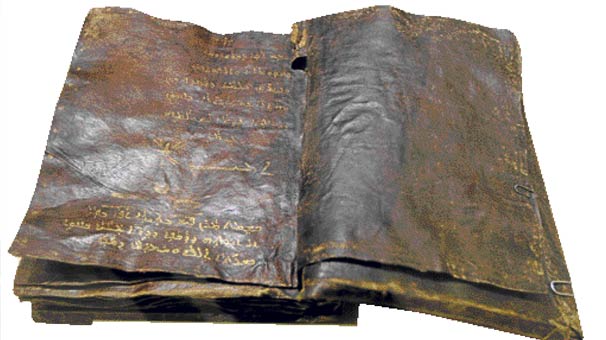
There Is an Accepted One and There Is a False One!
The original Gospel is not extant today. Both the Jews and the Romans had opposed the Prophet Isa (Jesus). Moreover, those who believed in him were very few. They were not an intellectual community. They were also deprived of state support. For this reason, they could not preserve the Gospel. The real Gospel was lost within the first one or two centuries. Perhaps it remained in memories and was never written down. For this reason, the first Christians did not possess a sacred book. The proclamation of the religion took place through sermons based on oral tradition. In order to facilitate the work of the preachers, small reference books had to be written. Thus, compilations narrating the life and words of the Prophet Isa were written. The books called the Gospels came into being in this way. They resemble the history literature in the Islamic world that narrate the life of the Prophet Muhammad. Beautiful counsels and anecdotes attributed to the Prophet Isa are included in them. However, the basis of Christian theology consists not of these but of the letters (epistles) of Paul.
At the Council of Nicaea in 325, among 54 such books known as Gospels, all narrated in the words of third persons, four named Matthew, Mark, Luke, and John were selected because their expression was simple, and the others were destroyed. Apart from these four, which are also known as the canonical (accepted) Gospels, the remaining Gospels are considered apocryphal (false) and have been forbidden by the Church. None of these are relics left by the apostles. They belong to centuries later. For this reason, Christians today say that there is actually no independent book called the Gospel, and that what is meant by the Gospel is the Prophet Isa himself, who is regarded as the word of God. As Paul said, they believe that the authors of the Gospels were inspired by the Holy Spirit while writing them.
The book that Christians call Holy Bible consists both of the Torah and the books connected to it under the name of the Old Testament, and also of the four Gospels under the name of the New Testament, as well as the adventures and letters of the apostles and Paul.
For centuries, many corrections, additions, and removals were made to the Gospel, and the final text was reached in the seventeenth century. The language of the Prophet Isa was Aramaic, which derived from Hebrew and is the ancestor of Syriac. Today it is spoken only by the Christians of the town of Malula near Damascus and by the Jews of Kurdistan. The Gospel was translated into Greek, then into Latin, and afterward into local languages; during these translations it lost much from its original. Christians read the Torah, but believe that its rulings have been abrogated. The Gospels of Catholics, Orthodox, and Protestants also differ from one another to some extent.
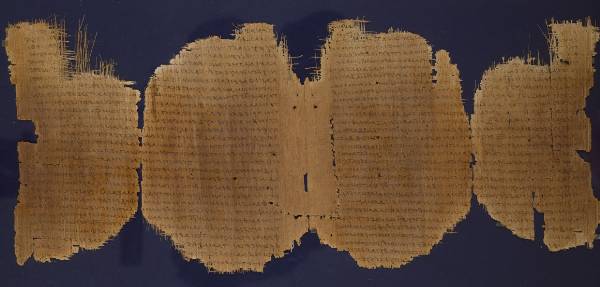
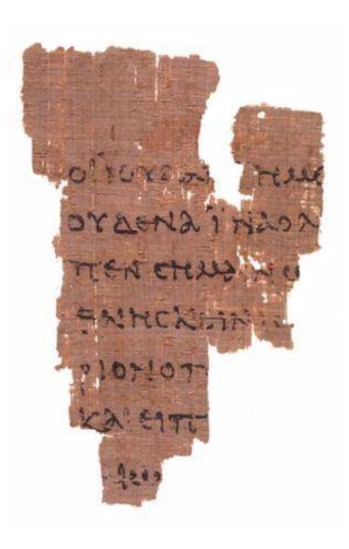
The Oldest Gospel Manuscript
The oldest known Gospel manuscript dates from AD 130–140. It was written in Greek on papyrus and was found in the Egyptian market in 1920. It is a fragment from the Gospel of John. It has been preserved in the Manchester John Rylands University Library since 1920.
In Dublin, Oxford, Geneva, and Barcelona there are Gospel fragments dating from the 200s, most of which were found in caves in Egypt or purchased in markets. The basis of today’s Gospel rests on two Greek manuscripts from the fourth century known as Vaticanus and Sinaiticus, which are kept in the Vatican and in London. Vaticanus was discovered in the sixteenth century by Erasmus. Sinaiticus was found in 1844 at St. Catherine’s Monastery on Mount Sinai by the Russian scholar Tischendorf and was purchased by the British government for 500 thousand dollars.
In 1947, two Bedouin shepherds in Jordan came across a bundle of parchments in a cave they entered while searching for their goat. It was revealed that the Hebrew parchments found in the Qumran cave on the shore of the Dead Sea were texts of the Torah. These documents came into the possession of the Syriac Patriarch of Jerusalem, and their contents were carefully kept hidden by Christian clergymen. After long struggles, the Jews bought them and recently placed them in the Jerusalem Museum.

The Adventure of the Gospel of Barnabas
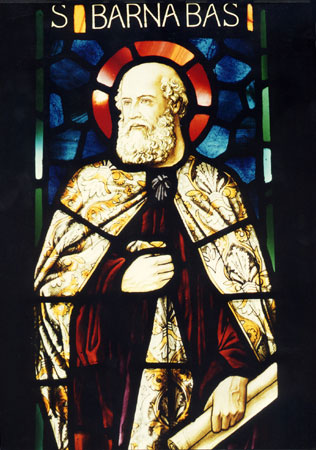
The Gospel written by the apostle Barnabas was read in the Eastern churches, for example in Alexandria, until the fourth century AD. Because Saint Barnabas opposed Paul, who is regarded as the founder of Christian theology, it was banned by the Church and disappeared.
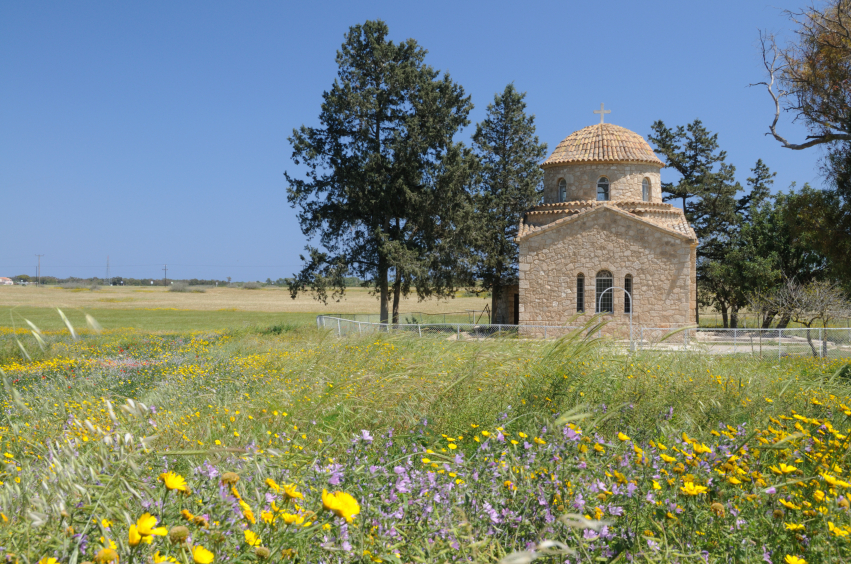
According to a narration, a manuscript copy in the author’s own handwriting was found in 478 in the tomb of Saint Barnabas in Cyprus. The bishop of Cyprus obtained autonomy from Istanbul in return for sending this. An Italian copy came into the hands of Pope Sixtus. One day in 1589, Father Marino, who was dining with him, took advantage of the pope’s falling asleep, found the book, and smuggled it away under his robe. This copy came into the possession of the famous Austrian Prince Eugene, who was fond of books. It is now in the Austrian National Library. Its English translation (1907) was reproduced and circulated by a Pakistani from the Washington Library of Congress. It is not possible to know whether this conforms to the original.
The Gospel of Barnabas is not very different from the others in that it gives place to the life and words of the Prophet Isa rather than conveying divine revelation. Because the name of the Prophet Muhammad appears in it many times, it is regarded by Christians as a text written by the Muslims of Spain in order to strengthen their religion. However, Muslim authors known for their studies on Christianity were not even aware of the Gospel of Barnabas for centuries.
A Completely Different Christianity
The Gospel of the apostle Thomas was found in 1945 in the town of Nag Hammadi in Egypt by two peasant brothers in a sealed jar in the form of 12 books. The Cairo Museum purchased them. The books date from the 200s AD. Unlike the other Gospels, it is not written in narrative style. It recounts 114 sayings of the Prophet Isa. Part of it is in Greek, and part is its Copt (Coptic) translation. Copt was the local language of Egypt. It is written with the Greek alphabet and is still used as a liturgical language by Egyptian Christians.
The Gospel of Judas, found in a cave in Minya, Egypt, in 1978, consists of papyri in the Coptic language whose original dates from the 200s and totals 62 pages. It was purchased by an antiquarian from Zurich. It is in the possession of the Maecenas Foundation in Switzerland. It was introduced to the world by the National Geographic Society, with which the foundation reached a financial agreement. It is the most interesting of the apocryphal Gospels. Here it is told that the apostle Judas did not betray the Prophet Isa but sacrificed himself. The Gospels of Thomas and Judas depict a completely different Christian belief. For this reason, they are the texts most strongly opposed by the Church.

Önceki Yazılar
-
ABORTION AND INDUCED MISCARRIAGE IN HISTORY9.09.2026
-
EUROPE SHOULD LEARN TOLERANCE FROM THE EAST2.09.2026
-
A SULTAN IN THE GRIP OF THE MASONS: MURAD V26.08.2026
-
AN ANCIENT GREEK TRADITION AMONG CHRISTIANS: THE BETTER THE DOWRY, THE BETTER THE HUSBAND19.08.2026
-
WHY DID THE PROPHET MUHAMMAD MARRY MULTIPLE TIMES? Understanding the Prophet Muhammad’s Marital Life12.08.2026
-
HOLY RELICS ADORNING ISTANBUL5.08.2026
-
AN OTTOMAN PRINCE IN THE DESERTS OF LIBYA29.07.2026
-
THE TURKS AT THE GATES OF VIENNA22.07.2026
-
THE SOLE FEMALE RULER OF TURKISH-ISLAMIC HISTORY15.07.2026
-
SIYASATNAMAS: THE FORGOTTEN SCHOOLS OF POLITICS8.07.2026