(1).jpg)
THE OTTOMAN DYNASTY OWES ITS LIFE TO A WOMAN
When the assassins who killed Sultan Selim III came to kill the Heir Apparent, Prince Mahmud, they found before them a brave woman who stood her ground. This lady, through her courage alone, changed the course of history.
Sultan Selim III, who devoted himself to regaining the years the country had lost since the Tulip Era, earned many enemies because of his undeniable successes. His boundless mercy brought about his end. Finally, in the year 1807, he was deposed by a coup. Such a thing had not happened since the deposition of Sultan Ahmed III in 1730. In Europe, the Industrial Revolution had not yet taken place. Had he remained on the throne, had his determination and resolve been stronger, the character of the country would have changed.
Sultan Selim had no children. He left the throne to his cousin Prince Mustafa, whom he had raised like his own son, and withdrew to his apartment in Topkapi Palace. Being the brother of the new sultan, he began to spend his time with the education and upbringing of Prince Mahmud, over whom he had doted since childhood.
.jpg)
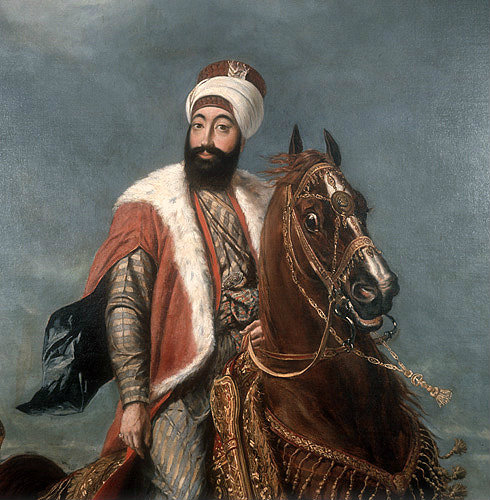
Were My Eyes Meant to See This?
The only person who grieved over Sultan Selim was Alemdar Mustafa Pasha, the ayan (provincial notable) of Ruse, who came to Istanbul with his troops in order to restore the sultan to the throne. First, he had Kabakçı Mustafa, the ringleader of the rebellion, who had married and entered the bridal chamber that very night, put to death. Then he visited the new sultan at Davudpasa Palace. He rejected the advice to arrest the sultan, saying it was unbecoming of honor, and thus a great opportunity was lost.
He forcibly took the seal of the grand vizier. After the ringleaders of the bandits were somehow neutralized, he marched on Topkapi Palace. On 28 July 1808, twenty people from among the Enderun aghas (Palace officers) who belonged to the rebels raided Sultan Selim’s apartment. The sultan’s consort Re’fet Kadinefendi threw herself upon those who entered with sabers in their hands, but she was struck down. Then, after chopping off the fingers of Pakize Kalfa, the treasurer who threw herself in front of the sultan, the sultan was martyred by a dagger blow he received to his right temple. One hundred eighty-six years earlier Sultan Osman II, and one hundred sixty years earlier Sultan Ibrahim, had also been martyred.
When Alemdar Mustafa Pasha arrived at the palace, he encountered the bloodied body of his benefactor, the former sultan, thrown at the gate. Embracing him and weeping, he said, “Alas, my lord, while I had come to seat you upon the throne once again, were my wretched eyes meant to witness this? Now let me take revenge on the murderers.” The sultan was forty-six years old.
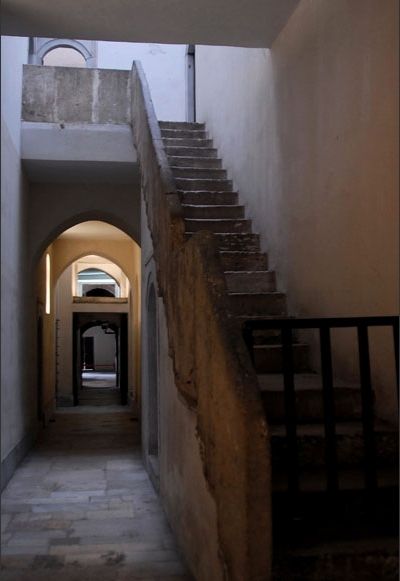
Dust and Smoke on the Golden Path
Let us return to the moment of the murder… After Sultan Selim, it was the turn of the Heir Apparent, Prince Mahmud Efendi. The rebels began to walk toward his apartment to kill the heir. Earlier, the başlala (chief royal tutor) Tayyar Agha had tried to confront and stop the rebels, but had barely escaped with his life and taken refuge in a barracks in the Enderun. At that moment, he encountered the prince’s tutor (lala) Mehmed Agha and learned that the assassins intended to kill the prince. He immediately came to the gate of the harem together with the imperial imam Hafiz Ahmed Efendi. Since he could not enter the harem, he informed three large, strong, and loyal harem aghas named Kasim, Anber, and Hafiz Isa, and sent them to the sultan. When the aghas entered with swords in their hands and saw that the sultan had been killed, they ran to the prince. However, his apartment was also empty.
The prince had been taken by his Circassian concubine Cevri Kalfa (Cevri Usta) to his apartment in the Harem-i Humayun (the imperial harem), in the corridor known as the Golden Path. Inside, he was waiting with a sword in his hand. This place was reached by a staircase. When the three aghas arrived at the head of the stairs by the shortest route, the assassins also caught up. Anber and Isa Agha held the top of the stairs. Kasim Agha, at the bottom of the stairs, fought for five minutes, then was wounded and collapsed to the ground. The prince’s life depended on gaining one or two minutes.
Suddenly, the door of the apartment opened. Cevri Kalfa, this strong and courageous girl, came out barefoot, with her skirt tucked into her waist. She shoveled the hot ashes from the brazier and flung them into the eyes of the rebels. The surroundings were filled with ash, smoke, and fire. Meanwhile, Isa and Anber Agha supported the prince and lifted him through the roof opening called the chimney in the corner of the room, onto the roof. Cevri Kalfa, exhausted of strength and ashes, collapsed to the ground after receiving a kick to the stomach. A dagger thrown by one of the rebels wounded the prince’s upper arm; his forehead, which he struck while fleeing, was also left covered in blood. At that moment, when it was heard that Alemdar had entered the palace, the rebels dispersed.
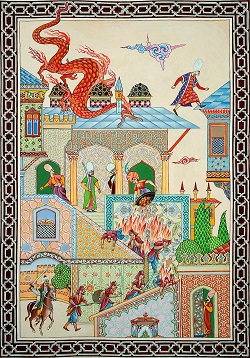
And Who Is This?
After this incident, which was like a scene from a film, the prince passed from the roof of the Haseki apartments to the roof of the Kushane (the harem’s kitchen); then, thanks to a ladder set up by two loyal aghas, he descended into the palace courtyard. Realizing that he had to save the heir apparent, Alemdar Mustafa Pasha moved forward, when Prince Mahmud appeared from the opposite side in a miserable state. Asking, “Hey, who is this?” and upon the imperial imam Ahmed Efendi saying, “It is our Sultan Mahmud Efendi,” he immediately took hold of the new sultan’s robe and pledged allegiance to him.
Sultan Mahmud stopped Alemdar, who wanted to go to the Enderun to take revenge for Sultan Selim. “Leave those matters aside, disperse your soldiers, and follow me,” he commanded. Together they walked to the Chamber of the Sacred Relics. The sultan appointed Alemdar as grand vizier. Following the funeral of Sultan Selim, nearly a thousand people connected with the murder were executed. Among them were ten concubines. The twenty-eight-year-old former sultan, Sultan Mustafa IV, was settled in Topkapi Palace, but upon an attempted coup four months later, he was executed.
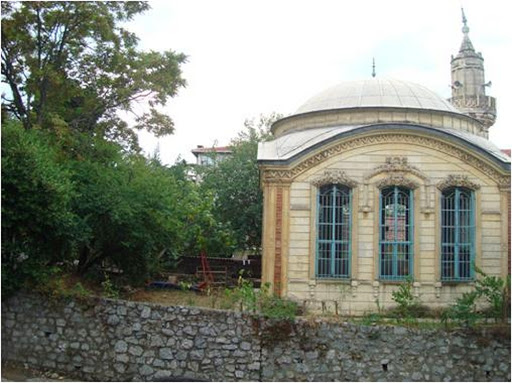
What a Woman Indeed!
This courageous effort of Cevri Kalfa saved the future of the Ottoman dynasty. Sultan Mahmud II, whose accession to the throne was a great fortune for Ottoman history, showed great respect and generosity to this devoted concubine. He first made her chief treasurer. He had a fine pavilion built in Big Çamlıca Hill and gifted it to her together with the extensive land surrounding it. This pavilion remained standing until the final years of the empire. The water in the garden of the pavilion was famous in Üsküdar as Cevri Kalfa Water. Cevri Kalfa, who passed away in 1826, is buried in the Nakşıdil Valide Sultan tomb in Fatih.
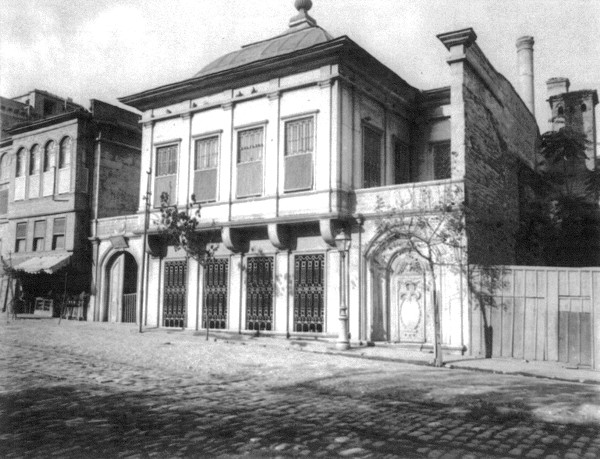
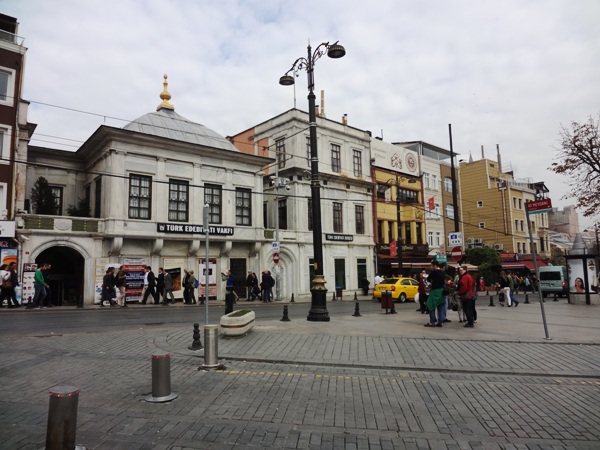
Cevri Kalfa, who won not only the sultan’s but all of Istanbul’s love and respect, built a primary school on Divanyolu in 1819; it is the largest of the schools in Istanbul. Its architectural style is original. In 1858, the building became a girls’ vocational school; after the republic, it was used as a printing house and a courthouse. Today, its lower floor consists of shops, and its upper floor is the Turkish Literature Foundation. Beside it are a sebil (charitable public water dispenser) and a fountain. The chronogram was composed with the line on its inscription, “May the soul of Cevri Usta be joyful through her school.” Cevri Kalfa built an elegant mosque on the right while going from Üsküdar Nuhkuyusu toward Bağlarbaşı. Sultan Abdulhamid II had it repaired.
Önceki Yazılar
-
ABORTION AND INDUCED MISCARRIAGE IN HISTORY9.09.2026
-
EUROPE SHOULD LEARN TOLERANCE FROM THE EAST2.09.2026
-
A SULTAN IN THE GRIP OF THE MASONS: MURAD V26.08.2026
-
AN ANCIENT GREEK TRADITION AMONG CHRISTIANS: THE BETTER THE DOWRY, THE BETTER THE HUSBAND19.08.2026
-
WHY DID THE PROPHET MUHAMMAD MARRY MULTIPLE TIMES? Understanding the Prophet Muhammad’s Marital Life12.08.2026
-
HOLY RELICS ADORNING ISTANBUL5.08.2026
-
AN OTTOMAN PRINCE IN THE DESERTS OF LIBYA29.07.2026
-
THE TURKS AT THE GATES OF VIENNA22.07.2026
-
THE SOLE FEMALE RULER OF TURKISH-ISLAMIC HISTORY15.07.2026
-
SIYASATNAMAS: THE FORGOTTEN SCHOOLS OF POLITICS8.07.2026